EYFS Curriculum
Every child. Every day. Every opportunity.
The EYFS is a unique and vital year that bridges the EYFS and Key Stage One. It gives children the foundations they need for lifelong learning through purposeful teaching, rich play and secure relationships.
The Early Years Foundation Stage (EYFS) is how the Government and early years professionals describe the time in your child’s life between birth and age 5. This includes children in our Nursery and Reception classes. This stage is very important as it helps prepare children for school and supports their future learning and success. From birth to age 5, children’s early experiences should be happy, active, exciting, fun and secure, while supporting their development, care and learning needs. All nurseries, pre-schools, Reception classes and registered childminders must follow the statutory Early Years Foundation Stage Framework, which sets the standards to ensure children learn and develop well, and are kept healthy and safe. It promotes teaching and learning to support ‘school readiness’ and provides children with a broad range of knowledge and skills as a strong foundation for future progress.
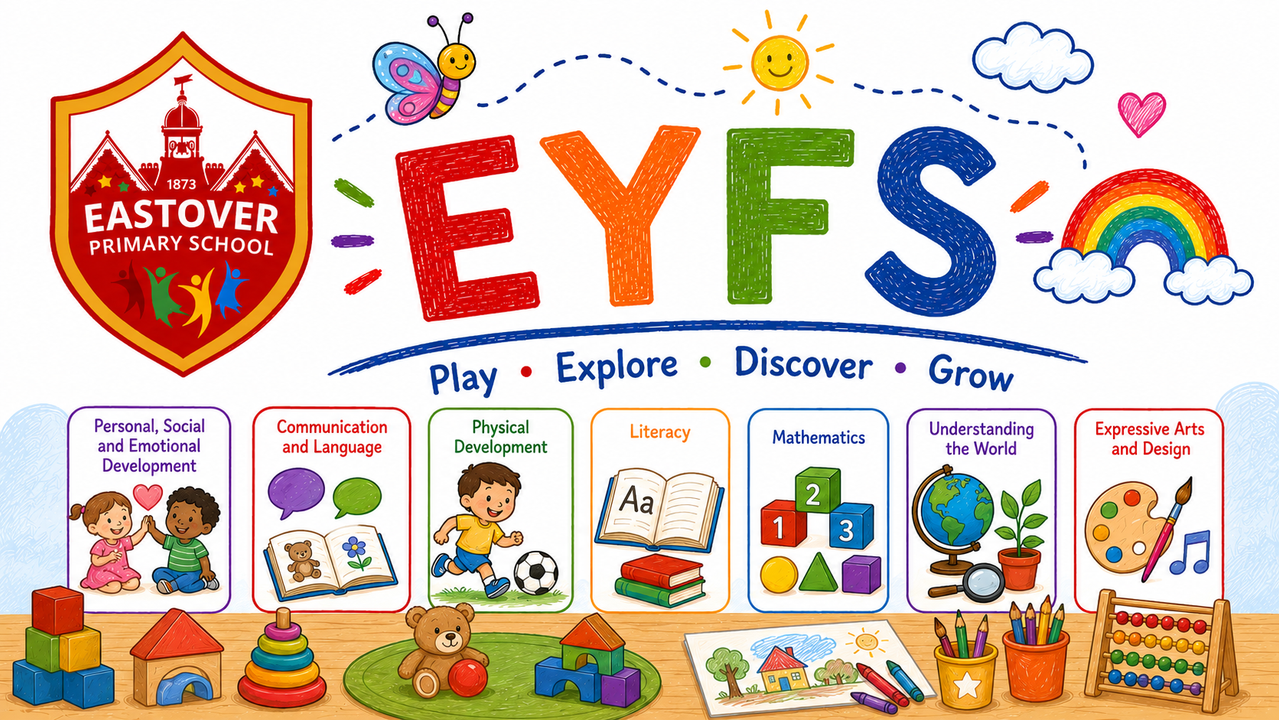
Within the EYFS, children are given opportunities to play and explore, investigate and experience new things, and ‘have a go’. They are encouraged to be active learners, developing their own ideas and interests. Every child is unique and will have different strengths and abilities, so learning is planned to meet individual needs. The areas of development are divided into two groups. The three prime areas—Communication and Language, Physical Development, and Personal, Social and Emotional Development—are the most essential for children’s healthy development and future learning. As children grow, these prime areas support development in four specific areas: Literacy, Mathematics, Understanding the World, and Expressive Arts and Design.
These seven areas are used to plan children’s learning and activities in a way that reflects their individual needs and interests. This is similar to a curriculum used in primary and secondary schools, but it is specially designed for young children and is flexible so that staff can respond to each child’s stage of development. At the end of Reception, children are assessed against the 17 Early Learning Goals, and their progress is shared with parents.
Intent, Implementation and Impact
At Eastover School, we are committed to providing a high-quality, inclusive and ambitious Early Years education where every child can thrive. Our curriculum is carefully designed to support the holistic development of all children, recognising that learning in the early years is interconnected and underpinned by strong relationships, communication and meaningful experiences.
Our intent is to ensure that every child receives the best possible start to their education. We provide a nurturing environment where children feel safe, valued and confident, enabling them to develop independence, curiosity and a love of learning. We maintain high expectations for all children, including those with SEND, and ensure that our curriculum is broad, balanced and accessible to every learner.
Our implementation is rooted in high-quality teaching, purposeful play and responsive practice. We deliver a carefully balanced curriculum through adult-directed teaching, adult-guided play and child-initiated learning opportunities. Our environments are designed to promote independence and exploration, and adults use skilled interactions to extend children’s thinking, language and understanding. Strong partnerships with families support children’s learning both at home and at school.
The impact of our approach is that children develop into confident, capable and enthusiastic learners. They make good progress from their starting points, demonstrate resilience and independence, and are well prepared for the transition into Key Stage 1.
Please see below for further details on each area of learning
Our Approach to Teaching and Learning in EYFS
Throughout the Early Years Foundation Stage (EYFS) at Eastover Primary School and Little Oaks Nursery, we follow the statutory Early Years Foundation Stage Framework. This framework sets out the learning and development requirements for young children and identifies the prime and specific areas of learning that form the basis of our curriculum. Our children are at the heart of everything we do, and the knowledge and concepts we teach are carefully chosen to be relevant, meaningful and engaging, while also building clear progression and strong links to future learning. Our core principles underpin all aspects of our practice: we build secure, trusting relationships, create calm and predictable routines, develop children’s independence, and foster curiosity and confidence. We plan learning with clear intent and adapt our teaching to meet the needs of all learners.
Our Early Years environments are designed to enable learning, with both indoor and outdoor areas thoughtfully organised and enriched with a wide range of open-ended, easily accessible resources. We provide a balance of adult-led and child-initiated activities, alongside sustained opportunities for open-ended play throughout the day. These experiences are carefully planned to be both engaging and appropriately challenging. All learning opportunities are designed to deepen understanding and support children in building secure foundations, helping them to make connections that will support their ongoing development and future learning.
Our Enabling Environment
Our Early Years environment at Eastover Primary School is language-rich, welcoming and safe, carefully organised and well resourced to support all areas of learning. It is designed to invite exploration, encourage curiosity and promote independence through thoughtfully planned spaces and accessible resources. High expectations, strong relationships, inclusive practice and purposeful play work together to create an enabling environment where every child feels valued and supported. Together, these elements ensure that every child at Eastover is able to thrive, develop confidence and achieve their full potential.
Understanding How Young Children Learn
At Eastover Primary School, we understand that young children learn in interconnected ways and develop best when their individual needs are recognised and supported. We place a strong emphasis on building secure, trusting relationships, as these form the foundation for all learning. Through sensitive interactions, we respond to children’s interests and help them to manage emotions, build resilience and feel confident in their environment. Our approach is language-rich, with daily opportunities for children to talk, listen and share ideas, while being introduced to new vocabulary through meaningful experiences.
We recognise the importance of physical development in supporting overall learning, and children are provided with regular opportunities to develop both gross and fine motor skills, promoting independence, confidence and early writing skills. Alongside this, we support children’s cognitive development by encouraging them to think, explore, solve problems and make connections through rich, engaging experiences that build curiosity, memory and understanding. Personal, social and emotional development is also at the heart of our practice, as we help children to understand their feelings, build friendships, manage relationships and develop self-regulation within a safe and nurturing environment.
At Eastover, we believe children learn best when they feel safe, valued, included, challenged and successful. Our carefully planned, well-organised and stimulating environment—combined with high expectations, inclusive practice, strong relationships and purposeful play—ensures that all areas of development are supported. By recognising that relationships, language, movement and learning are all connected and equally essential, we create an enabling environment where every child is supported to thrive and reach their full potential.
High Quality Teaching and Learning
At Eastover Primary School, we deliver high quality teaching and learning through a carefully balanced approach that includes adult-directed teaching, adult-guided play and child-initiated play. Through adult-directed teaching, key skills and knowledge are explicitly taught, building strong foundations for future learning. Adult-guided play allows staff to interact with children in the moment, supporting and extending their thinking through skilful questioning and shared experiences. Child-initiated play enables children to explore their own ideas, develop independence and build creativity and confidence. Across all of these approaches, we observe, plan and extend learning through meaningful and responsive interactions.
A strong emphasis is placed on the teaching of early literacy and mathematics. In literacy, children develop a love of reading through sharing texts daily, alongside systematic phonics teaching, rich vocabulary development, opportunities for meaningful talk, and shared and modelled writing. Early handwriting skills are also introduced to support writing development. In mathematics, children build deep understanding through practical, hands-on experiences, developing skills in counting, subitising, comparing, recognising patterns, solving problems and using mathematical language. The use of manipulatives and real-life contexts ensures that learning is meaningful and embedded.
Assessment in the Early Years at Eastover is continuous and responsive. Staff use careful observation, professional judgement and discussion to understand each child’s development and next steps. Assessment is used to support learning and inform teaching, ensuring that every child makes progress, rather than being focused on paperwork. Our approach is underpinned by the belief that mastery, repetition and meaningful learning are key, and that every child can achieve and thrive when given the right support, experiences and opportunities.
Please see below for our long term plan.
Inclusion, SEND and Creating an Enabling Environment
We are committed to ensuring that every child, including those with Special Educational Needs and Disabilities (SEND), can access a broad and balanced curriculum. We maintain high expectations for all children, adapting teaching to meet individual needs, identifying needs early and removing barriers to participation. Where appropriate, we use targeted support to help children succeed, ensuring that all learners are able to engage fully and make progress alongside their peers.
Our environment is carefully designed as an enabling “third teacher” that supports learning and development. It promotes independence, encourages curiosity and supports communication through a wide range of open-ended, accessible resources. The environment is well organised and predictable, helping children to feel secure while also offering opportunities for choice, creativity and exploration. Alongside this, we place a strong emphasis on supporting self-regulation. We help children to understand and express their emotions, manage frustration, persevere through challenges and develop independence. Adults play a key role in co-regulation, supporting children to build these skills through warm, responsive relationships.
At Eastover, we believe that when barriers are removed and teaching is adapted, all children can learn, belong and succeed. Strong relationships, inclusive practice and purposeful provision ensure that every child feels valued and supported. By working closely with families and maintaining a focus on meeting individual needs, we create an environment where every child can thrive socially, emotionally and academically.
Working with families
At Eastover Primary School, we recognise that children thrive when home and school work closely together, and we place great importance on building strong partnerships with families. We develop positive relationships with parents and carers, share children’s successes, and value the knowledge families have about their children. Regular communication, support with transitions and collaboration with other professionals ensure that every child is well supported throughout their early years journey.
Our skilled practitioners are knowledgeable about child development and use this expertise to deliver high-quality, responsive teaching. Staff carefully observe children, plan intentionally and use play-based learning to extend development and deepen understanding. Through a balance of modelling, guidance and child-initiated exploration, we support independence, language development and self-regulation, ensuring learning is meaningful and purposeful.
Our key messages underpin all aspects of practice at Eastover. We prioritise warm, secure relationships, place a strong emphasis on language development, and teach intentionally through play. We create enabling environments that inspire curiosity and exploration, while ensuring inclusion through adaptive teaching so that every child can access the curriculum. By working closely with families and maintaining high expectations, we provide every child with the strongest possible start, ensuring that all children feel supported, valued and able to achieve their full potential.