Religious Education
RE Lead- Miss Hall
"Faith is taking the first step even when you don't see the whole staircase." Martin Luther King
Intent
At Eastover Primary school, our intent is to provide an objective, high-quality education that prepares children to thrive as thoughtful, open-minded citizens in a diverse, global modern world. Religious Education (RE) sits at the very heart of our curriculum. We believe that RE is not just an academic subject, but a vital tool for fostering social harmony, empathy, and deep mutual respect. In a community enriched by diverse backgrounds, our RE curriculum acts as both a mirror—reflecting and validating our children’s own lived experiences and faiths—and a window—opening their eyes to the beliefs, values, and traditions of others.
Implementation
At Eastover Primary School, we aim to ensure that children:
-
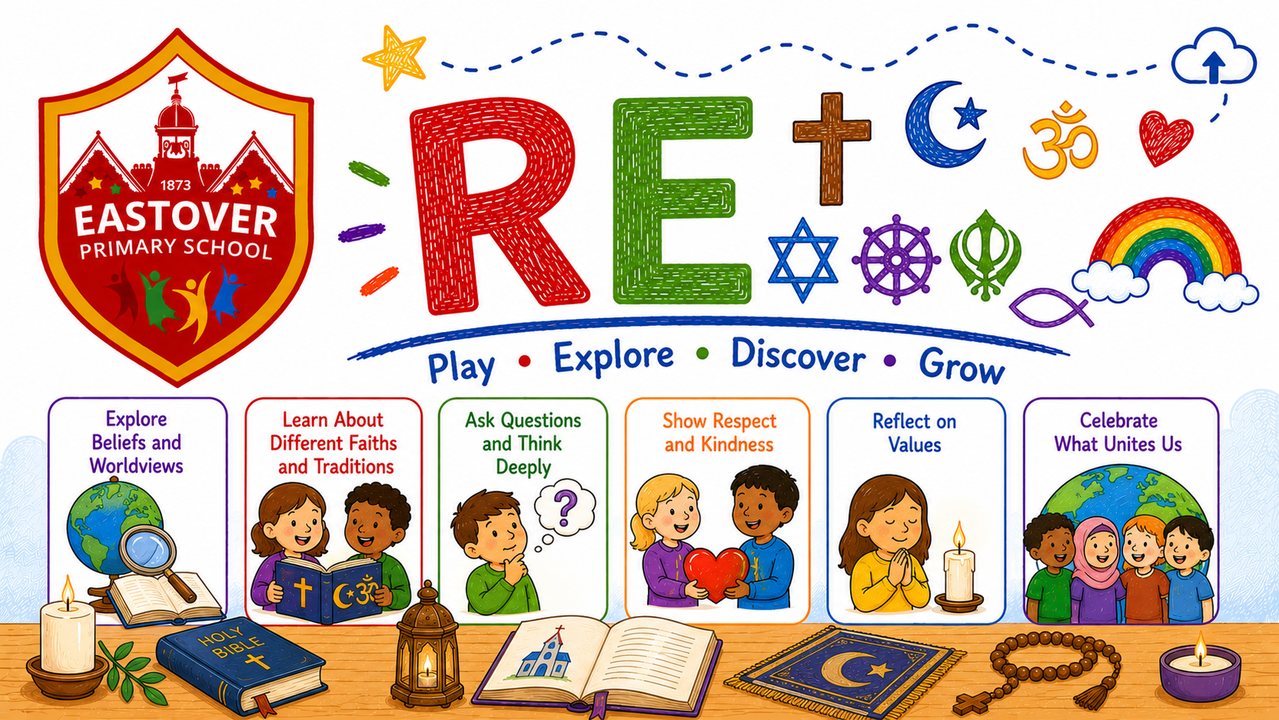
Learning ABOUT Religion and Beliefs (Knowledge): We deliver a rich, rigorous framework of religious literacy. Children explore the core beliefs, practices, sacred texts, and celebrations of the world's major religions (including Christianity, Islam, Hinduism, Sikhism, Judaism, and Buddhism), alongside non-religious worldviews such as Humanism.
-
Learning FROM Religion and Beliefs (Dialectic): We use RE as a vehicle for oracy and critical thinking. Children learn to ask challenging questions about meaning, purpose, and morality. They explore how different faiths answer life's big questions and how religious values drive people to make a positive difference in the world.
-
Celebrating Our Identity (Reflection): We explicitly utilise the rich cultural capital of our own school community. Our children are encouraged to share their traditions, creating a learning environment where diversity is not just tolerated, but actively celebrated.
The Role of SACRE in the RE Curriculum
While subjects like Maths and Science follow a strict National Curriculum set centrally by the government, Religious Education (RE) is determined locally. This is where SACRE (Standing Advisory Council on Religious Education) plays a critical role. SACRE ensures that our RE curriculum is legally robust, educationally sound, and perfectly tailored to celebrate the diverse, multi-faith community our children live in. It guarantees that our RE lessons are objective, inclusive, and expertly supported by a network of local faith leaders and education experts.
Impact
By embedding this multi-faith approach throughout their primary school journey, our RE curriculum aims to achieve a profound, lasting impact on our pupils' futures:
-
Combating Prejudice through Understanding: Ignorance breeds division. By teaching the realities, nuances, and shared values of different faiths, we dismantle stereotypes. Our children grow up resilient to prejudice, understanding that diversity is a strength.
-
Excellence in Oracy and Respectful Debate: Our RE classrooms are safe spaces for dialogue. Children learn the essential life skill of discussing sensitive topics respectfully. They learn to disagree agreeably, listen actively, and value opinions different from their own.
-
A Deepened Sense of Belonging: For children of faith, our curriculum validates their identity. For children from non-religious backgrounds, it provides a safe space to explore their own guiding moral principles. Every child leaves our school feeling seen, valued, and connected to their community.
Oracy and RE
RE asks big, abstract questions about existence, morality, identity, and the spiritual dimensions of life. For primary-aged children, these concepts can be difficult to grasp solely through reading and writing. By prioritising spoken language in RE, we ensure that children do not leave Eastover with a rigid, "textbook" understanding of faith. Instead, they transition to secondary education as articulate, confident, and empathetic communicators who can navigate the complex, diverse world-views of modern society with respect.